In 2026, school ERP software is no longer just a digital register for attendance and fee receipts. Principals now expect it to take care of NEP 2020 progress reports, keep student data ready for UDISE+ and APAAR ID, collect fees over UPI and WhatsApp, and use AI to point out problems before they grow. This guide explains what an AI-powered school ERP really does, which features matter for Indian schools today, and how to choose the right one.
What is an AI-powered school ERP?
A school ERP (Enterprise Resource Planning) system brings admissions, fees, attendance, exams, transport, HR and parent communication into one platform with one database. An AI-powered school ERP adds a layer of intelligence on top of that data. It does more than store records. It reads patterns in them and acts on them.
In practice, AI in a school ERP shows up in a few useful ways:
- Early warnings for students whose attendance or marks are dropping, so teachers can act early.
- Fee-defaulter prediction, so the accounts team can follow up with the right families before the due date, not after.
- Auto-drafted communication: circulars, report-card remarks and parent messages written in seconds and checked by staff.
- Smart dashboards that answer questions like "Which classes have the lowest fee collection this quarter?" without anyone building an Excel sheet.
- AI tutoring and learning support for students, linked to the same academic records.
For real examples from classrooms and school offices, see how AI is actually used in a school ERP.
Why Indian schools are moving to AI-powered ERP in 2026
Three things are pushing schools to upgrade their old school management software:
- Compliance has become data-heavy. NEP 2020, UDISE+ student-level data and APAAR ID all need clean, accurate student records kept year-round, not just at submission time.
- Parents expect a digital experience. They want instant attendance alerts, fee payment by UPI in a few taps, and updates on WhatsApp, not on paper diaries.
- Admin teams are stretched. The same office staff handle admissions enquiries, fee follow-ups, transport issues and government reports. Automation is the only way to keep up without hiring more people.
NEP 2020 compliance: Holistic Progress Cards
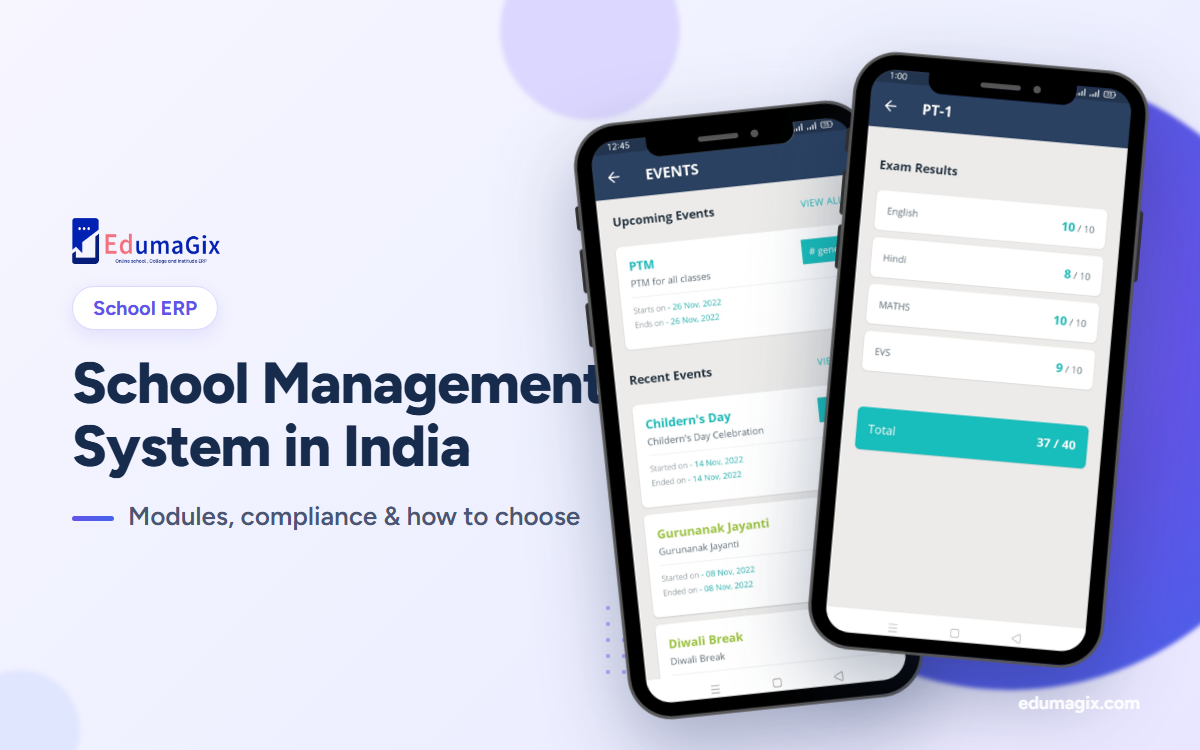
NEP 2020 moves schools from marks-only report cards to a Holistic Progress Card (HPC). The HPC records academic performance along with co-curricular activities, life skills, behaviour, and self and peer assessment. Doing this by hand for every student, every term, is a heavy load for teachers.
A NEP-compliant school ERP should let you:
- Set up assessment parameters and grading scales for each class and board (CBSE, ICSE or state board).
- Let teachers enter marks, observations and activity grades from a phone or laptop.
- Generate printable, ready-to-share progress cards in one click, including from marks the school already keeps in Excel.
- Use AI to suggest teacher remarks based on each student's performance, which staff can then review and edit.
UDISE+ and APAAR ID: why clean data matters
Every recognised school in India submits data on the UDISE+ portal, and that data is now collected at the student level. Students are given a PEN (Permanent Education Number), and the APAAR ID (Automated Permanent Academic Account Registry), part of the "One Nation, One Student ID" initiative, is a 12-digit ID that is created through UDISE+ with parental consent and linked to DigiLocker.
The usual problem is not the portal. It's the school's own records. A misspelt name, a date of birth that doesn't match Aadhaar, or missing parent details will cause APAAR creation to fail and UDISE+ submissions to be wrong. A good school ERP helps by:
- Keeping a single master record for each student from admission onwards.
- Flagging incomplete or mismatched fields (name, DOB, parent details) before they reach government portals.
- Storing PEN and APAAR ID against each student profile.
- Producing UDISE+-ready student reports from live data, so the annual submission is a report you download, not a month-long project.
WhatsApp and UPI fee collection
Fee collection is where a school ERP pays for itself fastest. Indian parents already use UPI and WhatsApp every day, so modern school fee management software meets them there:
- Online fee payment through UPI, cards and net banking via an integrated payment gateway.
- Automatic WhatsApp fee reminders before and after the due date, with a pay-now link.
- Instant digital receipts sent on WhatsApp the moment a payment succeeds.
- Flexible fee structures: monthly, quarterly or term-wise instalments, sibling and staff-ward concessions, scholarships and late fees.
- Defaulter reports and class-wise collection dashboards for management.
When fee data, reminders and payments all live in the same ERP, the accounts team stops matching bank statements against registers by hand, and parents stop getting reminders for fees they've already paid.
Must-have features of a school ERP in 2026
| Module | What to look for |
|---|---|
| Admissions & enquiries | Online enquiry capture, lead follow-up, admission forms, document collection |
| Student information system | Single student master, PEN/APAAR fields, transfer certificates, ID cards |
| Fee management | UPI/payment gateway, WhatsApp reminders, concessions, defaulter reports |
| Attendance | Biometric or app-based attendance, instant absence alerts to parents |
| Exams & report cards | NEP Holistic Progress Cards, board-specific grading, bulk printing |
| Parent communication | Official WhatsApp Business integration, SMS, mobile app, circulars |
| Gate & reception | Visitor log, student pickup verification, gate passes |
| AI & analytics | Risk alerts, smart dashboards, AI-drafted messages, AI tutoring |
| School website | Website connected to the ERP, so admission enquiries flow straight in |
How to choose the right AI-powered school ERP
Before you sign with any vendor, ask these questions:
- Is it built for Indian boards? Check CBSE, ICSE and state-board grading, and how the vendor handles changes when board guidelines change.
- Is the AI actually useful? Ask for a live demo of specific AI features, not just a slide that says "AI-powered".
- Is WhatsApp official? Messages should go through the official WhatsApp Business (Cloud) API, not unofficial tools that can get your number banned.
- Who owns the data, and where is it stored? Check security, backups and role-based access.
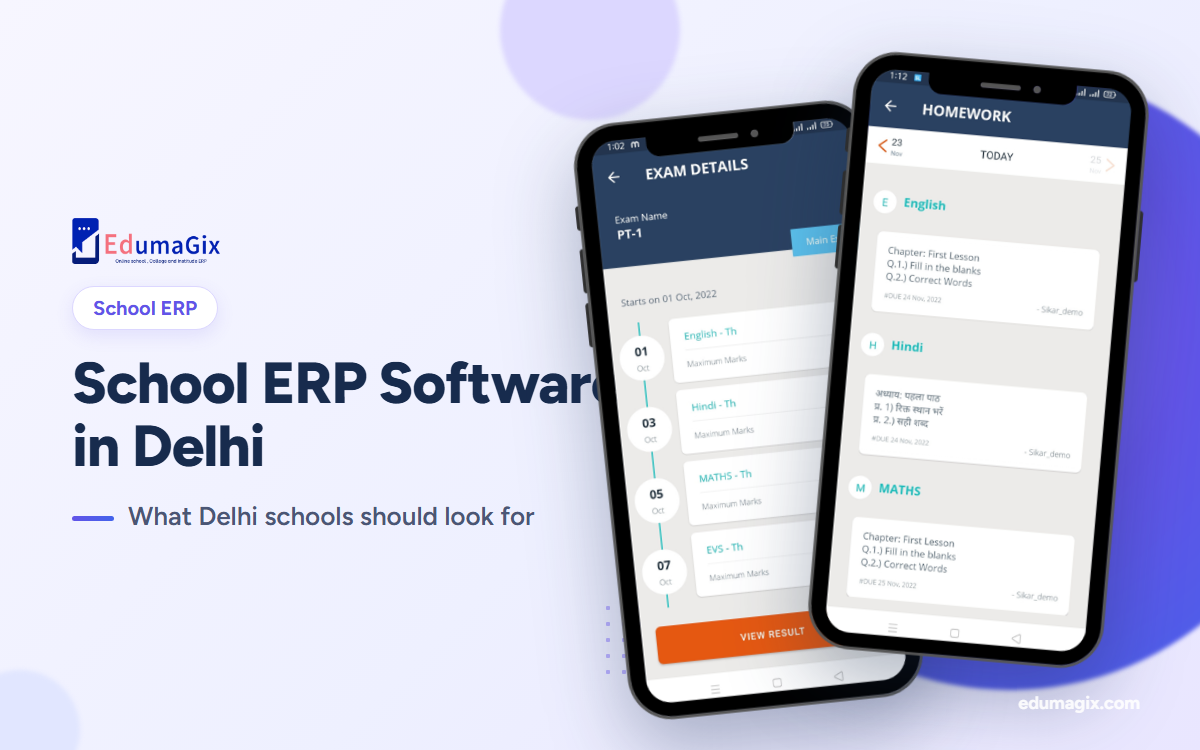
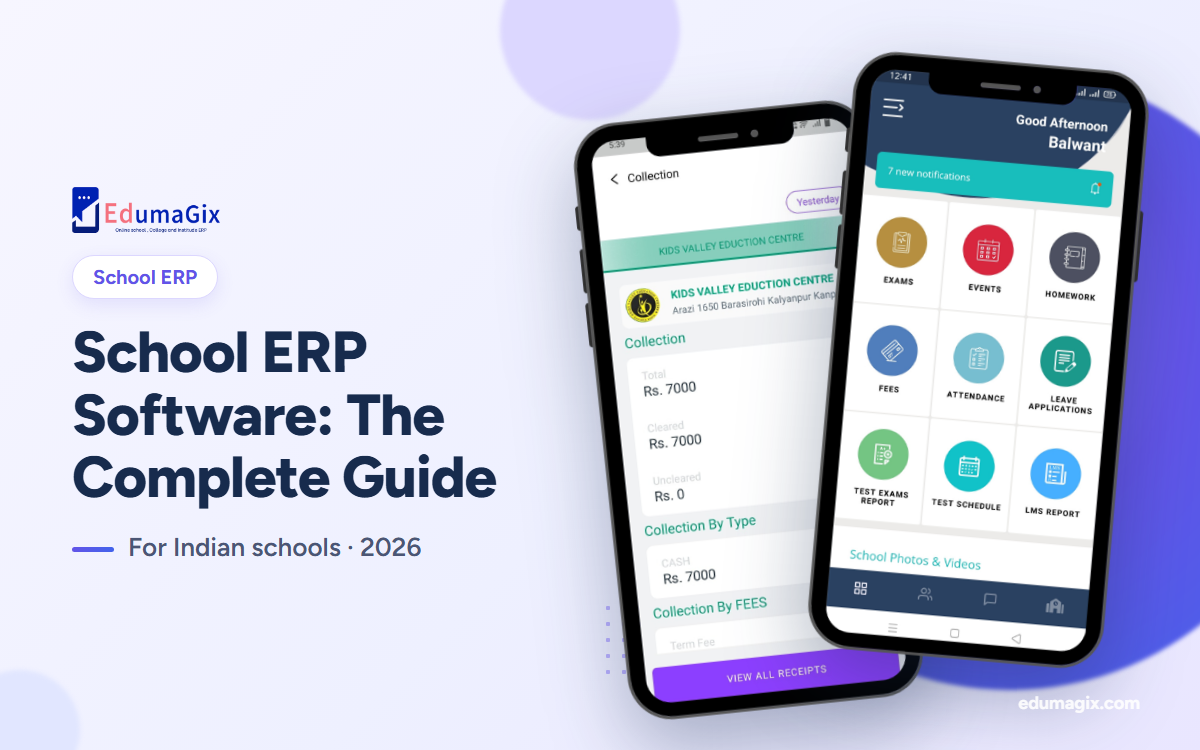
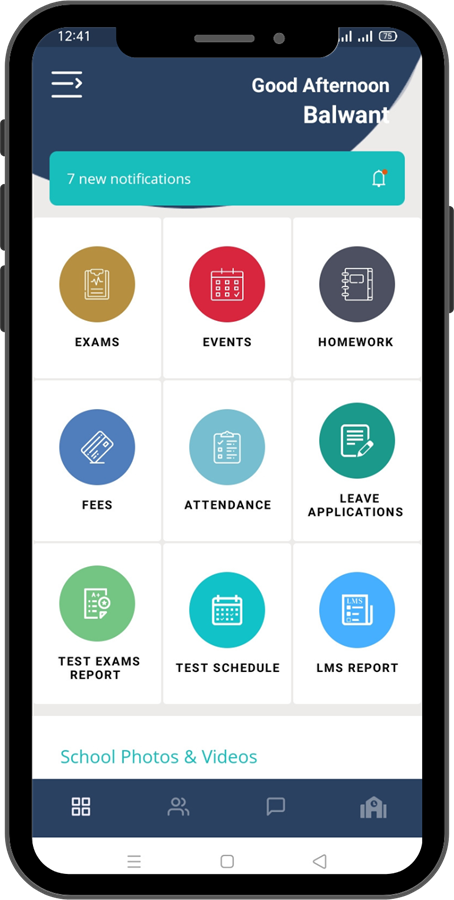
- Is there a mobile app for parents and teachers? Most daily use happens on phones.
- Does it integrate with accounting? Fee data should flow into your books without being typed in twice.
- What does onboarding look like? Ask who migrates your old data and trains your staff.
For a full module-by-module buyer's guide, read our complete school ERP software guide for Indian schools.
How EdumaGix helps
EdumaGix is a school ERP built in India for Indian schools by Dicor Infosystems, which has been building ERP software since 2002. It brings school administration, communication and growth into one package:
- School ERP on web and mobile, covering admissions, fees, attendance, exams and more.
- Online fee collection through a payment gateway, with WhatsApp alerts and reminders on the official WhatsApp Cloud API.
- Report card generation, including from the Excel files your school already maintains.
- Biometric attendance and reception/gate management.
- An ERP-integrated school website and admissions digital marketing with enquiry and lead management.
- Studia, an AI-powered learning platform for AI tutoring and course management.
Want to see it working with your school's own fee structure and classes? Book a free EdumaGix demo or write to sales@dicor.in.
Frequently asked questions
What is an AI-powered school ERP?
It is school management software that combines admissions, fees, attendance, exams and communication in one system, and uses AI to find at-risk students, predict fee defaults, draft messages and turn school data into simple dashboards.
Does a school ERP support NEP 2020 Holistic Progress Cards?
A modern school ERP should. Look for configurable assessment parameters covering academics, co-curricular activities and life skills, along with one-click generation of holistic progress cards for each term.
Can a school ERP help with UDISE+ and APAAR ID?
Yes. APAAR IDs are created through the UDISE+ portal, but most failures come from wrong student data. An ERP that keeps one verified student master record, with PEN and APAAR fields, makes UDISE+ submissions and APAAR creation much smoother.
Can parents pay school fees through WhatsApp and UPI?
With an integrated payment gateway, the ERP can send WhatsApp reminders with a payment link. Parents pay by UPI, card or net banking, and the receipt is sent back to them on WhatsApp automatically.
How long does school ERP implementation take?
For most schools, core modules such as admissions, fees and attendance can go live within a few weeks. A full rollout, including exams, transport and data migration, usually takes one to three months, depending on how clean the existing records are.
Is a school ERP the same as an LMS?
No. A school ERP runs administration: admissions, fees, attendance, reports and communication. An LMS (Learning Management System) delivers learning content and assessments. The best setups connect the two, so academic and administrative data stay in sync.