Almost every Indian school now runs at least part of its work on software. Choosing the right school management system is less about features on a brochure and more about fitting Indian realities: multiple boards, government data portals, part-payments of fees and parents who prefer WhatsApp to email.
School management system vs school ERP
The two terms are often used interchangeably. Strictly, a "school management system" usually means student records, attendance and fees, while a school ERP also covers accounts, HR, payroll, inventory and multi-branch operations. If your school is growing, choose a system that can scale up to a full ERP.
Modules Indian schools actually need
- Admissions and enquiries with lead follow-up
- Student information with documents, siblings and transfer certificates
- Fee management — instalments, concessions, late fees, online payment and receipts
- Attendance — manual, app, biometric or face recognition
- Exams and report cards matching your board's format
- Timetable and substitution
- HR and payroll
- Transport, library, hostel and inventory
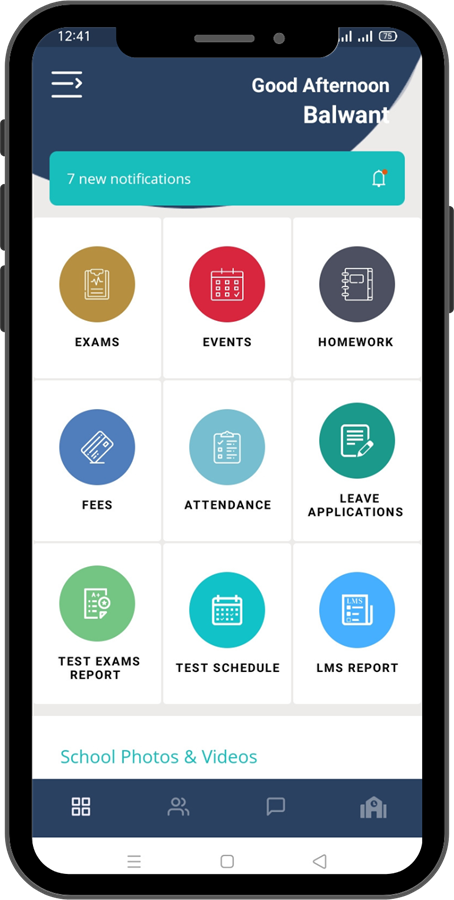
- Parent and teacher apps plus WhatsApp alerts
India-specific requirements to check
Board formats
CBSE, ICSE and state boards each have their own grading and report-card formats. Your system should let you configure these rather than forcing a single template. EdumaGix can even generate report cards from your existing Excel marks sheets.
Government data reporting
Schools regularly submit student and staff data to government portals such as UDISE+, and now maintain student IDs such as APAAR. A system with clean, complete student master data turns these submissions into a job of hours rather than weeks.
Indian fee realities
Quarterly and monthly instalments, sibling concessions, staff-ward waivers, RTE seats, route-wise transport fees and part-payments are normal. Test each of these in the demo.
Language and connectivity
Parent apps and messages should work in Hindi or the regional language where needed, and on low-end phones with patchy connections.
Cloud, mobile and data security
Cloud-based systems are now the default for Indian schools — no server to maintain and access from anywhere. Ask where data is hosted, how often it is backed up, and how parental consent is handled under the Digital Personal Data Protection Act.
Pricing models you will see
- Per student per year — common, scales with enrolment
- Flat annual licence — predictable, often better for larger schools
- Add-ons — SMS/WhatsApp credits, branded apps, biometric hardware, website
Always compare the total cost for your school's size, not the headline rate.
Vendor comparison checklist
- Does it solve our top five daily problems in a live demo?
- Who handles data migration and staff training?
- Is support available by phone, in our language, during our hours?
- Can we export all our data at any time?
- Are parent apps, WhatsApp and online fee payment included, or extra?
- Is there an AI layer and an LMS, or will we need separate tools?
EdumaGix for Indian schools
EdumaGix is a complete school management system and ERP built in India, for Indian schools — with parent and teacher apps, online fee collection, WhatsApp alerts and an AI tutor in one platform. Schools in the capital can also read school ERP software in Delhi.